
In traditional Christian theology, the covering cherub is widely interpreted as Satan (Lucifer) before he fell from grace. [1, 2]
Biblical Origin
The term comes from the Bible Tools Topical Discussion on the Anointed Cherub Who Covers, specifically in the Book of Ezekiel: [1]
- Ezekiel 28:14: “You were anointed as a guardian cherub, for so I ordained you. You were on the holy mount of God; you walked among the fiery stones.”
- Ezekiel 28:15: “You were blameless in your ways from the day you were created till wickedness was found in you.” [1, 2]
Key Interpretations
- Traditional View: Most Christian theologians view Ezekiel 28 as a description of a high-ranking, beautiful, and wise archangel who guarded God’s presence until pride led to his rebellion and expulsion from heaven. [1, 2]
- Historical Context: Some critical scholars and modern commentators note that the passage in Ezekiel 28 is literally directed at the human King of Tyre, using ancient mythological and heavenly imagery to describe his extreme pride and fall. [1, 2]
- Literary Symbolism: Writers like William Blake and literary critic Harold Bloom later used the “covering cherub” as a symbolic figure representing a barrier to truth or a hardened self-righteousness. [1]
If you’d like, I can share more about:
- The specific verses in Ezekiel and Isaiah connected to this figure
- The difference between cherubim, seraphim, and archangels
==================================================
The primary differences between cherubim, seraphim, and archangels lie in their closeness to God, their visual descriptions, and their assigned duties within the celestial hierarchy.
These distinctions come primarily from the Hebrew Bible, Christian theology, and the 5th-century angelic hierarchy established by Pseudo-Dionysius the Areopagite.
Direct Comparison
| Angel Type | Hierarchy Level | Key Role / Duty | Visual Appearance in Scripture |
|---|---|---|---|
| Seraphim | Highest Order (1st Triad) | Praising God’s holiness directly at His throne. | Six wings: Two cover the face, two cover the feet, and two are used to fly. Associated with fire. |
| Cherubim | Next Highest Order (2nd Triad) | Guarding sacred spaces and supporting God’s throne/chariot. | Four wings and four faces: human, lion, ox, and eagle. Covered in eyes. |
| Archangels | Lower Order (3rd Triad) | Delivering critical messages and executing God’s battles on Earth. | Typically appear as humans or warriors (often depicted with two wings in art). |
1. Seraphim: The Burning Ones
The Seraphim (singular: Seraph) are the closest to God’s throne. Their name literally translates to “burning ones” or “fiery serpents,” signifying their intense passion and love for God.
- Scripture: They only appear by name in Isaiah 6.
- Function: They continuously cry out, “Holy, holy, holy is the Lord of hosts; the whole earth is full of his glory.” They also purify Isaiah with a burning coal.
2. Cherubim: The Guardians
The Cherubim (singular: Cherub) serve as the ultimate guardians of holy domains and symbols of God’s majestic presence.
- Scripture: They first appear in Genesis 3 guarding the Tree of Life with a flaming sword. They are later described vividly in Ezekiel 1 and 10 as part of God’s mobile throne (the Merkabah).
- Function: They act as throne-bearers and protectors. Gold statues of cherubim covered the Ark of the Covenant. (Note: They look nothing like the cute, chubby babies popularized by Renaissance art).
3. Archangels: The Messengers and Warriors
Archangels belong to the lower tier of the angelic hierarchy. Because they are further from the throne, they interact directly with humanity. The prefix “arch-” means chief or ruler, meaning they lead the standard host of angels.
- Scripture: Only Michael is explicitly named as an archangel in the New Testament (Jude 1:9), though Gabriel serves the same prominent role. Intertestamental texts (like the Book of Enoch) name others, such as Raphael and Uriel.
- Function: They carry out monumental tasks on Earth. Gabriel delivers the Annunciation to Mary, while Michael leads heaven’s armies against demonic forces.
If you want to dive deeper, let me know if you would like to explore:
- The four faces of the Cherubim and what they symbolize
- How Satan (the covering cherub) fits into this specific ranking system
The four faces of the cherubim—described in the Book of Ezekiel—represent the chief domains of God’s creation and His supreme attributes. [1, 2]
As discussed in biblical commentaries and overviewed on platforms like Cherish the Best, each face symbolizes a distinct category of living creation and a facet of divine nature: [1, 2]
The Four Faces and Their Meanings
- The Lion: Symbolizes wild animals and majesty, representing fierce power, royalty, and courage.
- The Ox (or Calf): Symbolizes domestic/farm animals, representing strength, endurance, and faithful service.
- The Human (Man): Symbolizes humanity, representing intelligence, reason, compassion, and being made in the image of God.
- The Eagle: Symbolizes birds and the sky, representing swiftness, soaring vision, and divine transcendence. [1, 2, 3, 4]
Theological Interpretations
- Creation’s Head: Together, the four creatures represent the pinnacle of God’s creation on Earth (wild beasts, domesticated animals, mankind, and birds). [1]
- The Four Gospels: Many Christian theologians also draw a parallel between these four faces and the four portraits of Jesus Christ in the Gospels: Matthew (Lion/Royalty), Mark (Ox/Servant), Luke (Man/Humanity), and John (Eagle/Divinity). [1]
==============================================
Based on the 9 Levels of Angels Framework, Satan (before his fall) is positioned in the First Triad—the highest order of the angelic hierarchy. [1, 2]
Because the Bible explicitly labels him as the “anointed cherub who covers” (Ezekiel 28:14), he belonged to the second-highest rank of all creation. However, theologians and traditions elaborate on his exact placement within this system in a few distinct ways: [1]
1. The Preeminent Cherub (The Biblical View)
In the strict hierarchy, Cherubim rank just below Seraphim. However, Ezekiel 28:12 implies Satan wasn’t just a standard cherub; he was the apex of his order—described as the “seal of perfection, full of wisdom and perfect in beauty.” [1]
- The “Covering” Role: His specific assignment as the covering cherub meant he stood directly over or beside the throne of God. In the earthly Tabernacle, the gold cherubim physically “covered” the Mercy Seat where God’s presence rested. In heaven, Satan held this ultimate protective, high-priestly guarding position. [1, 2, 3, 4, 5]
2. The Seraphim Debate (The Theological View)
While Ezekiel uses the word “cherub,” many prominent Christian theologians (including St. Thomas Aquinas) argued that Satan actually belonged to the Seraphim, the absolute highest rank. [1, 2]
- The Logic: The angelic hierarchy is cumulative—higher ranks possess all the attributes of the lower ranks. Because Satan’s primary sin was supreme pride and a desire to be exalted above the stars of God (Isaiah 14:13), theologians argue his intellect and capacity for love/passion must have originated from the highest possible position—the “burning” Seraphim. Under this view, “cherub” in Ezekiel may have been used generally to mean a divine guardian. [1, 2, 3]
3. The Archangel Misconception (The Popular View)
In pop culture, Satan is frequently called a “fallen archangel,” but in the strict celestial hierarchy, this is technically a demotion. [1]
- Why the confusion? Archangels belong to the lowest triad. However, Satan is often pitted against Michael the Archangel in cosmic battles (Revelation 12:7). Michael is called an “archangel” because he is the chief commander of the earthly and military angelic armies. Satan’s rank was originally far higher than Michael’s operational rank, which is why Jude 1:9 notes that even Michael did not dare bring a slanderous accusation against Satan, but instead said, “The Lord rebuke you!” [1, 2, 3, 4]
Summary of His Placement
Satan was positioned at the very top of the hierarchy, either as the premier Cherub guarding God’s throne or as the highest of the Seraphim. His fall didn’t just empty a position; according to Christian tradition, he dragged one-third of the angels down with him, drawing followers from across all levels of the hierarchy (Revelation 12:4). [1, 2]
If you want to keep exploring, we can look into:
- How Thomas Aquinas argued for Satan being a Seraph vs. a Cherub
- The war in heaven and how Michael and Satan’s forces clashed
================================================
The cosmic clash between Michael and Satan’s forces is most famously detailed in the New Testament Book of Revelation (Chapter 12). [1, 2]
Because angels are entirely spiritual, non-physical beings, this “war in heaven” is not understood as a battle fought with physical swords, blood, or artillery. Instead, theologians, scripture, and tradition describe it as a titanic battle of wills, intellects, and spiritual authority. [1, 2]
The forces clashed across three major dimensions:
1. The Clash of Legal Authority: The Advocate vs. The Accuser
In the heavenly realm, the conflict is often framed as a cosmic legal battle. [1]
- Satan’s Force: Satan’s primary weapon is weaponized guilt. The name Satan literally means “The Accuser”. Before his final eviction, his strategy was to stand before God and demand the condemnation of humanity based on their sins and failures (as seen in the Book of Job). [1]
- Michael’s Force: Michael’s weapon is the Blood of the Lamb and divine justice. Michael’s forces did not win by their own power, but by enforcing the legal reality of Christ’s sacrifice. By paying the debt for human sin, Jesus stripped Satan of his legal right to accuse humanity. Michael acts as heaven’s “baliff,” physically executing the eviction order now that Satan has lost his legal standing. [1, 2, 3]
2. The Clash of Identities: “Who is like God?” vs. “I will be like God”
The battle was fought intensely on the battleground of truth and pride. [1, 2]
- Satan’s Force: Lucifer’s rebellion was built on self-exaltation. His battle cry—reflected in Isaiah 14:14—was “I will make myself like the Most High.” His forces fought to establish an independent kingdom of self-will and autonomy from God. [1]
- Michael’s Force: The name Michael is not just a name; it is a battle cry. In Hebrew, Mîkhā’ēl translates to a question: “Who is like God?” Michael’s entire force was unified under total submission and humility to God’s supreme authority. Every time Satan claimed he could match God, Michael’s forces countered with the ultimate truth that God has no equal. [1]
3. The Structural Breakdown: The Legions
The clash split the celestial hierarchy down the middle, with a massive imbalance of power: [1]
- The Rebel Army: Satan successfully corrupted one-third of the heavenly host (symbolized as “stars” swept from the sky by the dragon’s tail in Revelation 12:4). This army consisted of high-ranking principalities, powers, and thrones who chose pride over service.
- The Loyal Army: Michael led the remaining two-thirds of the angelic host. While Satan may have outranked Michael individually in terms of raw native power (as a preeminent Cherub/Seraph), Michael was backed by the infinite power of the Holy Spirit and commanded a vast numerical majority. [1, 2]
The Ultimate Outcome
Scripture notes that the clash was decisive: “…but he was defeated, and there was no longer any place for them in heaven.” (Revelation 12:8). [1]
Because spiritual beings cannot be physically destroyed or “killed” like humans, the defeat meant a permanent loss of access and authority. Michael and his loyal angels completely overwhelmed the rebel forces, forcefully casting Satan and his demons out of the heavenly realm and down to the earthly/mortal sphere. [1, 2]
Would you like to explore:
- How the Book of Enoch or other historical texts expand on this battle?
- What scripture says about the final battle between them at the end of time?
=====================================================
Scripture reveals that the final battle at the end of time is a complete anticlimax. While popular culture depicts a long, dramatic struggle, the Bible Gateway entry on Revelation 20 describes a swift, absolute execution of divine judgment rather than a prolonged war. [1]
Furthermore, Michael the Archangel does not fight Satan in this final showdown. Michael’s primary role was executing the initial eviction of Satan from heaven to the earth during the Tribulation period (Revelation 12). At the very end of time, the conflict is handled entirely by God Himself. [1, 2, 3]
According to scripture, the true final battle unfolds in three specific stages:
1. The Imprisonment (The Millennium)
Before the absolute final battle, the Scripture account of the Millennial Kingdom notes that an unnamed angel descends from heaven with a great chain. [1]
- He seizes Satan and binds him in a bottomless pit (the Abyss) for 1,000 years.
- During this millennium, the Earth experiences a period of absolute peace under Christ’s reign, completely free from demonic deception. [1, 2]
2. The Great Deception (Gog and Magog)
The Scripture text on Satan’s Final Defeat states that when the thousand years are over, Satan is released from his prison for a “little season” to test the hearts of those born during the millennium. [1, 2]
- Despite living in a literal utopia under Christ, a massive portion of humanity chooses to rebel the moment the Accuser returns.
- Satan gathers an army from the four corners of the earth—symbolically referred to as Gog and Magog—whose numbers are “as numerous as the grains of sand in the sea.”
- This massive global army marches across the earth and completely encircles the “camp of the saints” and the beloved city of Jerusalem. [1, 2]
3. The Instant Outfire (The Final Verdict)
Just as the rebel army prepares to strike, there is no hand-to-hand combat, no clashing of swords, and no military strategy. [1]
The Bible summarizes the entire “battle” in a single verse:
“They marched across the breadth of the earth and surrounded the camp of God’s people, the city he loves. But fire came down from heaven and devoured them.“ — Revelation 20:9 [1]
The Ultimate Fate of Satan
Following this sudden destruction, Satan receives his final, permanent sentencing. He is not sent to “rule” hell; rather, he is cast into it as its ultimate prisoner: [1, 2]
- “And the devil who deceived them was thrown into the lake of fire and sulfur, where the beast and the false prophet are too, and they will be tormented there day and night forever and ever.” — Revelation 20:10 [1]
This event marks the absolute end of the Covering Cherub’s existence and influence, paving the way for the creation of a New Heaven and a New Earth. [1]
If you’d like to look closer at the prophetic timeline, we can explore:
- Why theologians believe Satan must be released for a “short time” instead of destroyed immediately
- The difference between the Battle of Armageddon (Rev 19) and this Final Revolt (Rev 20)
===================================================
In mainstream premillennial theology, the Battle of Armageddon (Revelation 19) and the Final Revolt (Revelation 20) are two entirely distinct conflicts. They are separated by exactly 1,000 years (the Millennium) and feature different leaders, participants, and outcomes. [1, 2]
Direct Comparison
| Feature | The Battle of Armageddon (Rev 19) | The Final Revolt / Gog & Magog (Rev 20) |
|---|---|---|
| Timing | Occurs before the 1,000-year Millennial reign. | Occurs after the 1,000-year Millennial reign. |
| The Instigator | Led by the Antichrist (the Beast) and the False Prophet. | Led directly by Satan (after his release from the Abyss). |
| The Rebel Forces | Earthly armies gathered via demonic deception. | Post-Millennial humans who choose to rebel. |
| Location | Geographically centered near Megiddo / Valley of Jezreel. | Globally encompassing; surrounds the Camp of Saints (Jerusalem). |
| How It Ends | Jesus returns physically and slays the army with a sword. | Fire falls from heaven instantly from God the Father. |
| The Fate of Evil | The Antichrist and False Prophet are thrown into the Lake of Fire; Satan is bound. | Satan is thrown into the Lake of Fire permanently. |
1. The Battle of Armageddon (Revelation 19)
This battle marks the climax of the Tribulation period. Humanity has spent years under the deceptive rule of the Antichrist (the Beast). [1, 2]
- The Setup: The Antichrist gathers the geopolitical military forces of the world to the geographic location of Armageddon (Har-Megiddo in Israel). Their goal is to completely wipe out Israel and wage war against the concept of God. [1, 2, 3]
- The Climax: Heaven opens, and Jesus Christ physically returns to Earth on a white horse, followed by the armies of heaven. [1, 2]
- The Result: Jesus defeats the armies instantly using the “sword of His mouth” (His spoken word). The Antichrist and False Prophet are captured and become the very first occupants of the Lake of Fire. Satan is captured, bound with a chain, and locked away in the bottomless pit. [1, 2]
2. The Final Revolt (Revelation 20)
Often referred to by its symbolic name, the Battle of Gog and Magog, this is the true final armed conflict in the biblical timeline. [1, 2]
- The Setup: For 1,000 years, Jesus rules the Earth in perfect peace and justice. At the end of this millennium, Satan is released for a short time to test the generations of humans born during this utopian period. Despite living under Christ’s perfect reign, millions of people instantly choose to follow Satan the moment he returns. [1, 2, 3]
- The Climax: Satan gathers a global army from the “four quarters of the earth”. Instead of massing at Megiddo, they march across the globe and lay siege to the physical city of Jerusalem (“the camp of the saints”). [1, 2]
- The Result: Jesus does not ride down on a horse this time—He is already reigning on Earth. Instead, God the Father executes immediate judgment: fire falls out of heaven and completely vaporizes the attacking armies. Satan is then picked up and thrown into the Lake of Fire to join the Antichrist forever. [1, 2]
Summary of the Progression
Think of Armageddon as the battle that establishes Christ’s physical Kingdom on Earth by eliminating corrupt human governments. The Final Revolt is the subsequent cleanup 1,000 years later that permanently eliminates sin, death, and Satan from existence before the creation of the Eternal State. [1, 2, 3]
If you’d like, we can explore:
- What Gog and Magog means in Revelation 20 versus its original meaning in the Book of Ezekiel
- What happens immediately after the Final Revolt at the Great White Throne Judgment
=======================================================
Immediately after the Final Revolt is crushed, the Great White Throne Judgment begins as the final courtroom of human history. According to Revelation 20:11-15, this event represents the definitive execution of justice where the “wicked dead” (i.e., unbelievers from all generations) are physically resurrected to God’s ultimate verdict. [1, 2, 3, 4]
The text outlines exactly what happens during this final cosmic court session across five specific events:
1. The Dissolution of the Cosmos
The moment the Judge sits upon the throne, physical reality collapses. Revelation 20:11 states that the “earth and the heaven fled from his presence, and there was no place for them.” The current physical universe is completely dismantled, meaning this final trial takes place in a transcendent spiritual realm outside of ordinary time and space. [1, 2]
2. The Universal Resurrection of the Dead
Every person who died without a relationship with God is forcefully summoned. [1, 2]
- The Sea, Death, and Hades (Hell): The text notes that these three realms are emptied, delivering up their dead.
- Body and Soul Reunited: Hades (the temporary holding place of the wicked dead) releases their souls, while Death (the grave) releases their physical matter. They are reconstructed into eternal physical bodies capable of standing before the throne.
- “Small and Great”: No one is exempt. Tyrants, kings, billionaires, and the completely obscure stand side-by-side. [1, 2, 3]
3. The Opening of the Books
The trial relies on absolute, flawless documentation. Two distinct sets of books are opened before the Judge: [1]
- The Books of Works: These contain a perfect, unfiltered record of every single action, word, thought, and motive of the individuals on trial. Because they chose to be judged by their own righteousness rather than accepting Christ’s sacrifice, they are evaluated purely on their deeds. [1, 2, 3]
- The Book of Life: This registry contains the names of everyone redeemed by the blood of Christ. In this court session, it is opened exclusively to prove a negative—to verify that the defendant’s name is completely absent from it. [1, 2, 3]
4. The Final Verdict and “The Second Death”
There are no defense attorneys, appeals, or negotiations. The evidence from the books is definitive, and every knee bows in acknowledgement of God’s perfect justice. [1]
- Anyone whose name is not found written in the Book of Life is cast into the Lake of Fire.
- This permanent banishment from the presence of God is explicitly defined by scripture as “the second death.” [1]
5. The Destruction of Death and Hades
In a final act of sweeping authority, Death and Hades themselves are thrown into the Lake of Fire. Because all human souls have now reached their permanent, eternal destinations, the temporary structures of human mortality and temporary punishment are completely dissolved. [1]
What Happens Immediately After the Judgment?
The moment the Great White Throne Judgment concludes and sin is permanently quarantined in the Lake of Fire, human history officially ends and eternity begins. [1]
As detailed in Revelation 21, God immediately creates a New Heaven and a New Earth, bringing down the Holy City (the New Jerusalem) where He will physically dwell with redeemed humanity forever, completely wiping away every tear, sorrow, and death.
If you want to wrap up this timeline, we can look at:
- The New Jerusalem and what life looks like in the Eternal State
- How the Judgment Seat of Christ (Bema Seat) for believers differs from this White Throne Judgment
=======================================================
The Judgment Seat of Christ (often called the Bema Seat) and the Great White Throne Judgment are completely separate events in Christian theology.
The most critical difference is that the Bema Seat is a ceremony of rewards for believers, while the Great White Throne is a trial of condemnation for unbelievers.
Direct Comparison
| Feature | The Judgment Seat of Christ (Bema Seat) | The Great White Throne Judgment |
|---|---|---|
| The Defendants | Believers only (the Church / Saved individuals). | Unbelievers only (the Wicked Dead). |
| The Location | Takes place in the heavenly realm. | Takes place in a transcendent void after the current universe flees away. |
| The Timing | Occurs after the Rapture/Resurrection of the Church. | Occurs at the very end of time (post-Millennium). |
| The Purpose | To evaluate eternal rewards and heavenly crowns. | To determine the degree of eternal punishment. |
| The Tone | An awards ceremony (like the Olympic podium). | A criminal sentencing (like a high court verdict). |
| The Outcome | Eternal life is already guaranteed; loss or gain of rewards. | Eternal banishment into the Lake of Fire. |
1. The Judgment Seat of Christ (The Bema Seat)
The term comes from the Greek word Bema, which referred to the raised platform in ancient Greece where judges sat to watch athletic games and hand out medals to the winners.
- The Scripture: Detailed primarily in 2 Corinthians 5:10 (“For we must all appear before the judgment seat of Christ…”) and 1 Corinthians 3:10-15.
- Salvation is Not on Trial: The people at this judgment are already saved. Their eternal destiny is settled. Instead, their lives are evaluated to see how faithfully they served Christ after they were saved.
- The “Fire” Test: 1 Corinthians 3 explains that a believer’s works are tested by fire. Works done with pure, godly motives are like “gold, silver, and precious stones” and survive the fire. Works done out of selfishness, pride, or fake piety are like “wood, hay, and straw” and burn up.
- The Result: If a believer’s works burn up, they suffer the loss of rewards, but scripture explicitly notes: “the builder will be saved, but only as one escaping through the flames.” Those whose works survive receive eternal crowns and varying levels of authority in the Kingdom.
2. The Great White Throne Judgment
In contrast, this is a somber, terrifying criminal court session where there is no mercy, only absolute divine justice.
- The Scripture: Found exclusively in Revelation 20:11-15.
- Salvation is the Issue: The people standing here rejected God’s grace during their earthly lives. Because their names are not found in the Book of Life, they have no Savior to pay for their sins.
- The Result: They must pay for their own sins. They are judged by their deeds to determine their level of punishment in the Lake of Fire, followed by permanent banishment from God’s presence.
Summary Analogy
To put it simply: The Bema Seat is like an athletic awards banquet at the end of a season where everyone on the team gets into the banquet hall, but some receive trophies while others do not. The Great White Throne Judgment is a maximum-security sentencing hearing where guilty defendants receive their final, irreversible prison sentences.
We have covered the timeline from Satan’s origin to the final judgment. If you’d like to conclude, we can look at:
- The five types of heavenly crowns believers can win at the Bema Seat
- What the Bible says about the New Earth and Eternity once these judgments are over
======================================================
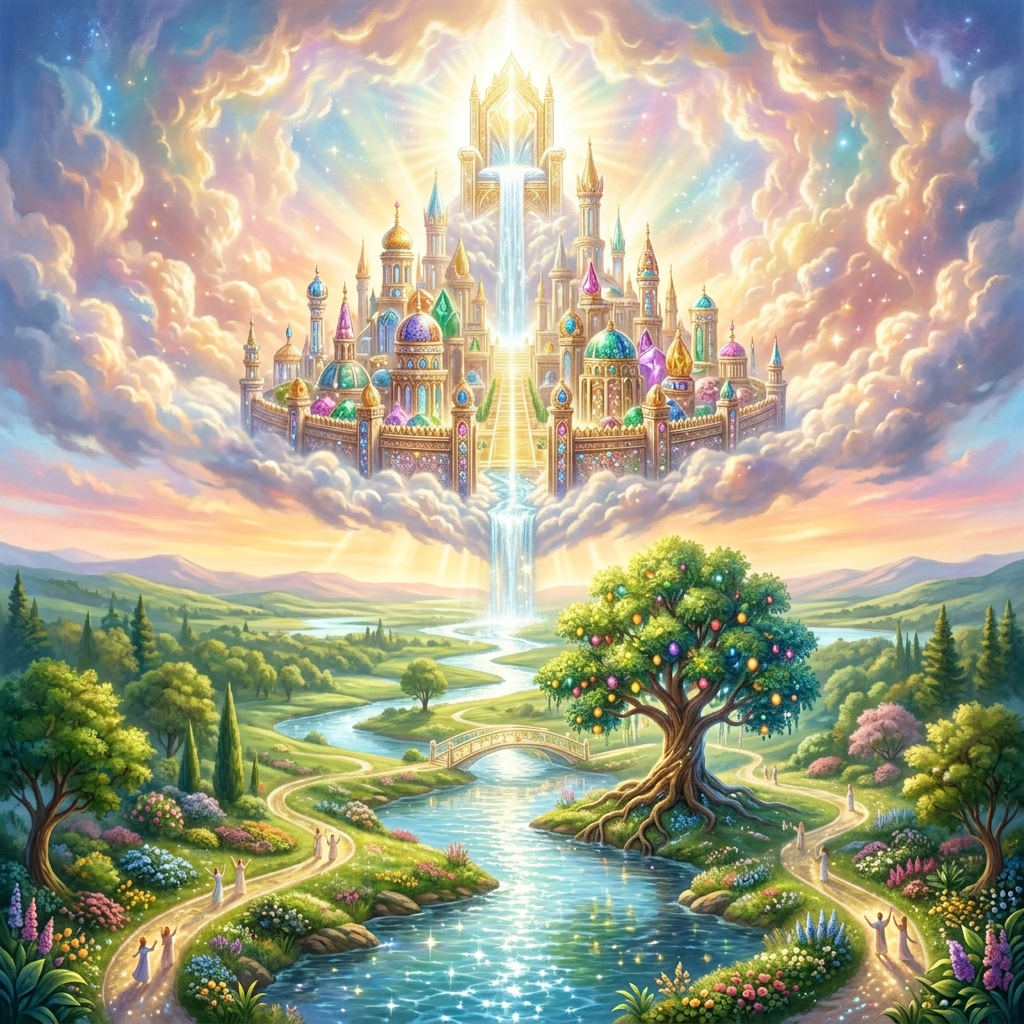
With the final judgments complete and sin permanently eradicated, Revelation 21 and 22 introduce the Eternal State, characterized by a radical convergence of heaven and earth.
Instead of believers spending eternity “up in the clouds,” God completely recreates the physical universe (a New Heaven and a New Earth) and relocates His throne directly to the earthly realm. The capital city of this pristine cosmos is the New Jerusalem.
The Architecture of the New Jerusalem
The New Jerusalem is described as a breathtaking, colossal metropolis descending out of heaven. It serves as the physical home for God, the angels, and all redeemed humanity.
- The Immense Dimensions: Revelation 21:16 states the city is laid out as a perfect cube, measuring 12,000 stadia on each side. In modern measurements, this is roughly 1,400 miles wide, 1,400 miles long, and 1,400 miles high—stretching approximately from Canada to Mexico and reaching deep into the atmosphere.
- The Cosmic Materials: The city glows with brilliant light, constructed of pure gold as clear as glass. Its foundation walls are layered with twelve types of precious gemstones (such as jasper, sapphire, and emerald), and its twelve entry gates are made from solid, individual pearls (the literal “pearly gates”).
- The Missing Temple: Unlike ancient Jerusalem, there is no temple building. The text states that the Lord God Almighty and the Lamb are its temple. God’s physical presence is fully open and accessible to everyone; there is no longer a curtain or barrier separating humanity from the Creator.
What Life Looks Like in the Eternal State
Life in the Eternal State is not a static, boring harp-strumming session. It is a dynamic, highly active existence characterized by perfected physical and spiritual reality.
1. Perfect Physical Restoration
Humanity lives in resurrected, incorruptible physical bodies. Every trace of the broken, fallen world is permanently erased. The Bible famously promises that God will wipe away every tear, and there will be no more:
- Death
- Sorrow or crying
- Pain or disease
- Night or darkness (because the glory of God provides constant, perfect light)
2. Creative and Meaningful Work
Believers are not idle. Scripture notes that “His servants will serve Him” (Revelation 22:3) and that humanity will “reign forever and ever” (Revelation 22:5). This implies that human beings will continue to exercise stewardship, create, govern, and explore the vast, unblemished new creation. It is a life of limitless learning, discovery, and purposeful activity without the exhausting frustration of fatigue, corruption, or failure.
3. Deep Community and Relational Harmony
The New Jerusalem is a global, multicultural society. The “kings of the earth” and people from every nation, tribe, and tongue bring their cultural splendor into the city. Because sin, selfishness, jealousy, and pride are completely gone, human relationships are marked by flawless love, absolute trust, and deep community.
4. The River and Tree of Life
Flowing directly from the throne of God through the middle of the city’s main street is the River of the Water of Life, bright as crystal. On either side of the river stands the Tree of Life, bearing twelve crops of fruit—one for every month. The text notes that the leaves of the tree are for the “healing (or wholesome thrive) of the nations,” symbolizing the continuous, eternal replenishment of human vitality.
The Ultimate Climax
The entire story of scripture—which began in Genesis with humanity being barred from the Tree of Life in a garden—ends in Revelation with humanity fully restored inside a magnificent garden-city. The ultimate fulfillment of the Eternal State is summed up in the absolute intimacy of Revelation 22:4: “They will see His face, and His name will be on their foreheads.”
We have traveled the entire biblical timeline from the Covering Cherub’s origin to the creation of the New Earth.
=================================================
At the Judgment Seat of Christ (Bema Seat), the New Testament outlines five distinct heavenly crowns (stephanos in Greek, referring to the laurel wreaths awarded to victorious Olympic athletes) given to believers as rewards for their faithfulness, service, and endurance during their earthly lives.
The Five Heavenly Crowns
1. The Incorruptible Crown (The Crown of Self-Discipline)
This crown is awarded to those who demonstrate consistent self-control, discipline, and spiritual endurance, mastering their fleshly desires to run the Christian race effectively.
- The Scripture: 1 Corinthians 9:25-27 — “Everyone who competes in the games goes into strict training. They do it to get a crown that will not last, but we do it to get a crown that will last forever.”
- The Focus: Personal holiness, spiritual focus, and avoiding distractions that derail faith.
2. The Crown of Rejoicing (The Soul-Winner’s Crown)
This crown is given to believers who actively share the Gospel and invest their lives in bringing others to faith in Jesus Christ.
- The Scripture: 1 Thessalonians 2:19 — “For what is our hope, our joy, or the crown in which we will glory in the presence of our Lord Jesus when he comes? Is it not you?” (See also Daniel 12:3).
- The Focus: Evangelism, discipleship, and sharing the message of salvation.
3. The Crown of Righteousness (The Crown for Loving His Appearing)
This reward is reserved for those who live their lives with an eternal perspective, eagerly anticipating and longing for the physical return of Jesus Christ, allowing that hope to purify how they live daily.
- The Scripture: 2 Timothy 4:8 — “Now there is in store for me the crown of righteousness, which the Lord, the righteous Judge, will award to me on that day—and not only to me, but also to all who have longed for his appearing.”
- The Focus: Hope, loyalty to Christ’s kingdom over the world, and living in constant readiness for His return.
4. The Crown of Life (The Martyr’s Crown)
This crown is awarded to believers who endure severe trials, testing, and persecution for their faith, particularly those who remain faithful all the way unto physical death.
- The Scripture: James 1:12 & Revelation 2:10 — “Do not be afraid of what you are about to suffer… Be faithful, even to the point of death, and I will give you life as your victor’s crown.”
- The Focus: Courage, perseverance under immense pressure, and martyrdom.
5. The Crown of Glory (The Shepherd’s Crown)
This specific crown is designated for Christian leaders, pastors, elders, and teachers who faithfully shepherd, protect, and guide God’s people with pure motives, humility, and a servant’s heart.
- The Scripture: 1 Peter 5:2-4 — “Be shepherds of God’s flock that is under your care… And when the Chief Shepherd appears, you will receive the crown of glory that will never fade away.”
- The Focus: Leadership, spiritual mentorship, humility, and faithful ministry oversight.
What Do Believers Do with These Crowns?
Scripture indicates that these crowns are not meant to be worn as symbols of eternal pride or status over others.
In Revelation 4:10-11, a snapshot of heaven shows the twenty-four elders (representing the unified body of believers) instantly casting their crowns before the throne of God. The underlying theology is that because any good work a believer did on Earth was only possible through the grace and power of the Holy Spirit, all the glory ultimately belongs back to Jesus. The crowns are won specifically so that believers have a tangible offering of worship to give back to the King.
Now we have traced this entire epic from Satan’s original rebellion to the final rewards of the saints.
=======================================================


Leave a comment