which has more mass electron or quarks
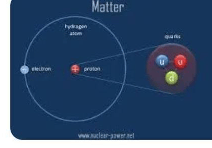
Quarks generally have more mass than an electron, though it depends on which quark flavor you compare. [1, 2, 3]
- Electron mass: The electron has a mass of about 0.511 MeV/c² (or roughly \(9.11 \times 10^{-31}\text{ kg}\)). [1, 2]
- Lighter quarks (Up and Down): The up quark has a mass of about 2 MeV/c², and the down quark has a mass of about 4.8 MeV/c², making both of them several times heavier than an electron. [1, 2]
- Heavier quarks: Other quark flavors are vastly more massive. For example, the top quark has a mass of about 173,210 MeV/c², which is hundreds of thousands of times heavier than an electron. [1, 2, 3]
Would you like to know more about how quark masses contribute to protons and neutrons, or how particle masses are measured?
Of Particular SignificanceStandard Model: How the Proton is Greater than the Sum of its …The mass of a single proton, often said to be made of three quarks, is almost 1 GeV/c2. To be more precise, a proton’s mass is 0.9…
QuoraAre quarks more massive than electrons? – QuoraQuark Mass Comparisons: Heavy quarks (e.g., top, bottom, charm) have pole masses significantly greater than the electron’s 0.511 M…
QuoraAre quarks more massive than electrons? – The Science Space – QuoraMass Comparison: Quarks are generally more massive than electrons (0.511 MeV/c^2). Quark Types: Six flavors exist (up, down, stran…

Show all
sure
Energy, not just the quarks themselves, makes up most of the mass in protons and neutrons.
While up and down quarks are heavier than electrons, adding their individual masses together only accounts for about 1% of a proton or neutron’s total mass. The remaining 99% comes from the intense kinetic energy of the quarks moving at near-light speed and the binding energy of the gluons (the particles that carry the strong nuclear force holding the quarks together). This phenomenon is a direct real-world demonstration of Einstein’s famous equation, \(E=mc^2\), where energy manifests physically as mass.
Licensed by Google
How Quark Sub-Components Build Atoms
| Particle | Quark Composition | Sum of Quark Masses | Actual Measured Mass |
|---|---|---|---|
| Proton | 2 Up + 1 Down | ~8.8 MeV/c² | 938.3 MeV/c² |
| Neutron | 1 Up + 2 Down | ~11.6 MeV/c² | 939.6 MeV/c² |
How Physicists Measure These Invisible Masses
Because of a property called color confinement, quarks can never be isolated or pulled apart to be weighed individually on a “scale.” Instead, particle physicists must calculate their masses using two primary indirect methods:
- Lattice QCD (Quantum Chromodynamics): Scientists simulate the complex, churning grid of quarks and gluons inside a supercomputer. By matching these complex mathematical simulations to the known, real-world masses of protons and mesons, they can accurately deduce the rest mass of the individual quarks.
- High-Energy Collisions: By smashing particles together inside massive accelerators like the CERN Large Hadron Collider, physicists observe the debris and energy decay signatures left behind. Tracking these subatomic “footprints” allows them to precisely calculate the mass of incredibly heavy, short-lived particles like the top quark.
Would you like to explore how lattice QCD simulations work, or look closer at the six different flavors of quarks?
let’s look at the six different flavors
The Standard Model organizes the six flavors of quarks into three distinct generations, increasing dramatically in mass from the first generation to the third. [1, 2]
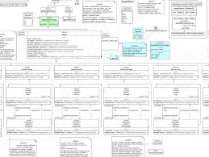
There are six types of quarks (and six antiquarks) | Webel …
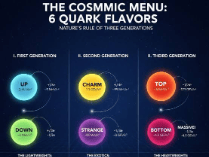
Headline: 🍨 The 6 Flavors that Build the Universe! Did you …
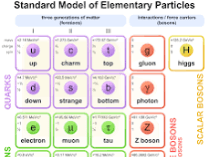
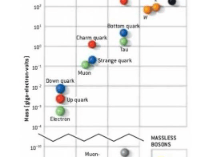
Ask Ethan: Why Are There Only Three Generations Of Particles?
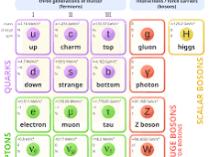
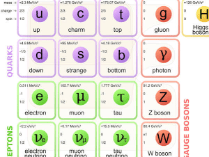
Ask Ethan: Why Are There Only Three Generations Of Particles?
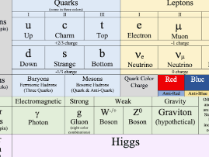
The Standard Model of Particle Physics – Forsyth Astronomical Society
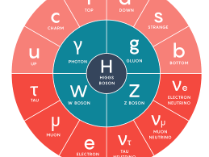
Why Do Matter Particles Come in Threes? A Physics Titan Weighs In …
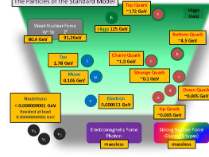
The Known (Apparently-) Elementary Particles – Of Particular …
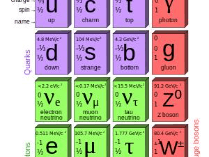
The Standard Model of Particle Physics
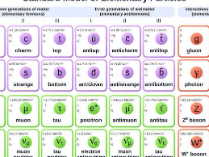
The particles in the early Universe painted a different picture – Big …
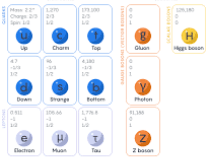
How Many Elementary Particles Are There, Really? | Quanta …
The Three Generations of Quark Flavors
| Generation | Flavor | Electric Charge | Approximate Mass |
|---|---|---|---|
| First Generation | Up (u) | +2/3 [0.6.2/0.6.13] | ~2.2 MeV/c² |
| First Generation | Down (d) | -1/3 [0.6.2/0.6.13] | ~4.7 MeV/c² |
| Second Generation | Strange (s) | -1/3 [0.6.2/0.6.13] | ~96 MeV/c² |
| Second Generation | Charm (c) | +2/3 [0.6.2/0.6.13] | ~1,280 MeV/c² |
| Third Generation | Bottom (b) | -1/3 [0.6.2/0.6.13] | ~4,180 MeV/c² |
| Third Generation | Top (t) | +2/3 [0.6.2/0.6.13] | ~173,000 MeV/c² |
Key Characteristics of the Flavors
- First Generation (Up and Down): These are the lightest and most stable quarks. They form the everyday matter around us, combining to make the protons and neutrons in atomic nuclei. [1, 2, 3]
- Second Generation (Strange and Charm): These are heavier and unstable. Strange quarks were named for the unusually long lifespans of the particles they formed, while charm quarks helped complete the theoretical symmetry of the Standard Model. They only exist naturally in high-energy environments like cosmic ray collisions or particle accelerators. [1, 2, 3]
- Third Generation (Bottom and Top): These are massive. The top quark is the heaviest known elementary particle in physics, weighing roughly as much as an entire gold atom despite being a point-like fundamental particle. Because they decay in a tiny fraction of a second, third-generation quarks require massive accelerators to produce and study. [1, 2, 3]
Would you like to learn more about how the weak force allows quarks to change from one flavor to another, or look at the leptons (like the electron) that mirror these three generations?
WikipediaQuark – WikipediaThe heavier quarks rapidly change into up and down quarks through a process of particle decay: the transformation from a higher ma…
Study.comQuark Definition, Flavors & Matter – Lesson – Study.comTop quarks are the most massive quarks. Top quarks. quarks are elementary or fundamental entities or units of matter. There are si…
Physics Stack ExchangeWhy are quark types known as flavors?Dec 1, 2010 — The third quark is called strange. It was named after the “strangely” long lifetime of the K particle, the first composite particl…


Show all
how did quarks first come to be bound together into a proton
Quarks first bound together into protons during a monumental cosmic event known as hadronization, which occurred exactly one millionth of a second (\(10^{-6}\) seconds) after the Big Bang. [1, 2]
This process unfolded in a series of steps driven by the rapid cooling of the infant universe: [1]
1. The Melting Pot: Quark-Gluon Plasma
In the earliest fractions of a second, the universe was unimaginably hot and packed with energy. Temperatures exceeded two trillion Kelvin. Under these extreme conditions, the universe was filled with a “soup” known as quark-gluon plasma. Because the thermal energy was so immense, quarks and gluons zipped around freely, colliding too violently to ever stick together. [1, 2, 3, 4]
2. The Cosmic Cool-Down
As the universe rapidly expanded, it began to cool down. At the one-microsecond mark, the temperature finally dipped below the critical threshold of two trillion Kelvin. At this point, the average thermal energy of the universe dropped below the binding energy of the strong nuclear force. [1, 2]
3. The Strong Force Takes Over
As the ambient heat faded, the strong nuclear force—carried by gluons—overpowered the chaotic kinetic energy of the particles. Gluons began acting like subatomic “glue,” snapping the freely roaming quarks into permanent, localized groups. [1, 2, 3]
4. The Birth of the Proton
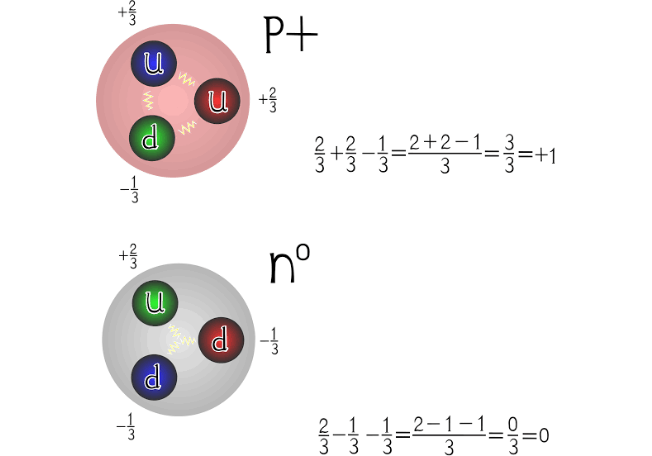
Through a property called color confinement, quarks were forced to group up into combinations that neutralized their “color charge,” making them collectively “colorless”. [1]
- Two up quarks (each with a +2/3 electric charge) and one down quark (with a -1/3 charge) pulled together.
- Bound inextricably by a constant, violent exchange of gluons, their combined electric charges added up to exactly +1. [1, 2, 3]
This specific combination froze out of the plasma as the very first protons. Because protons are highly stable, those exact same particles that bound together in the first microsecond of time still make up the nucleus of every hydrogen atom in the universe today. [1, 2, 3]
Would you like to explore what happened next in the timeline, such as how those protons fused into the first atomic nuclei, or how scientists recreate the quark-gluon plasma today at the Large Hadron Collider?


Leave a Reply